Surface vs. Suspended: Two Ways to Install a Magnolia Underdeck
July 26, 2026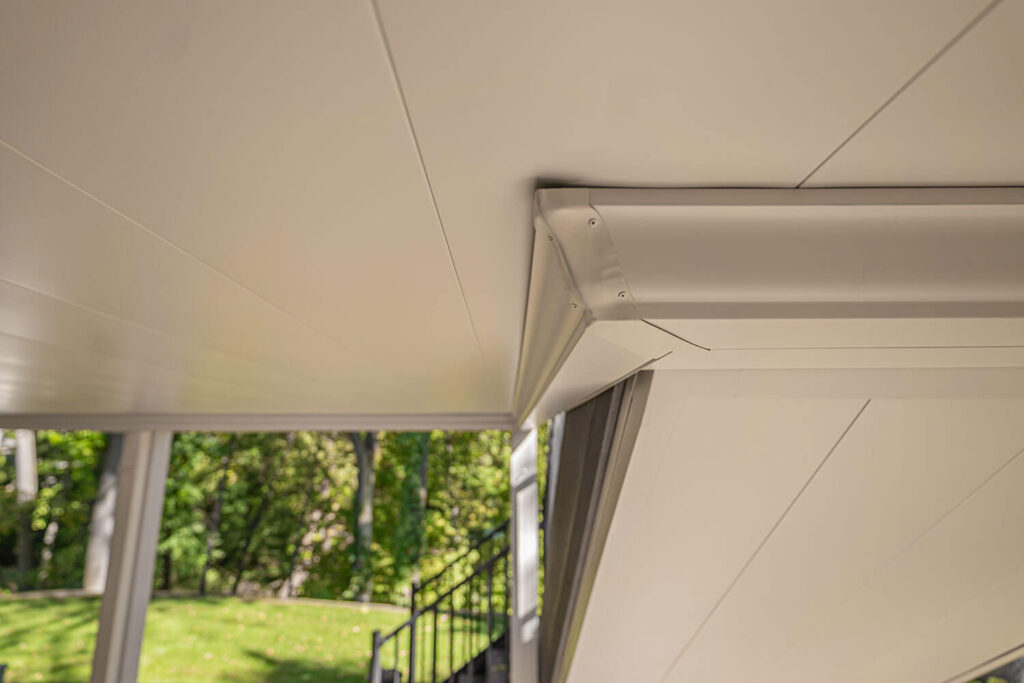
Under Deck Gutter Systems: How Deck Drainage Meets Your Gutters
By Jason Kolstad, Owner,
When you're looking at your options for under deck drainage, you might find yourself looking only at the ceiling panels. But barely anyone ever looks twice at the gutters, and we think that's backwards! The underdeck panels just move the water from one side of your deck to the other. The gutter is where every gallon from your entire deck is going to end up, and in our experience, it's where poorly planned systems give up.
Here's how the gutters of an under deck system works, what separates gutters done right from bolted-on afterthoughts, and what you should ask about no matter whose system you're planning on buying.
What does an under deck gutter actually handle?
Let's do the math on a decent rainstorm. An intermediate-sized storm in MN can drop between a half and 2 inches of water. So let's use a storm that drops an inch of rain as an easy example. An inch of rain on a 300 square foot deck is going to generate about 187 gallons of water, and all of it has to exit cleanly through one gutter run at the deck's low edge. And that exit isn't always a quick and easy one, for instance, a spring melt is definitely slower but nastier, because it comes with ice, grit and everything winter left on your deck.
So the gutter on an under deck system has a job that can often be harder than the ones on your roof. It collects debris that washes through the deck boards, and it can't rely on a steep roof pitch to keep itself flushed clean. Undersize it or pitch it lazily and the system backs up right over the heads of where people are sitting.

Where the gutter sits depends on the system type
It can be helpful at this point to make a distinction between the types of underdeck systems. There are a few ways that these systems set up their gutters. In an above-joist trough system (Trex RainEscape and similar), each joist bay drains through its own small downspout. The collection gutter receives water from a dozen little outlets spaced along the run, typically one every bay or every 12 to 14 feet of trough. This isn't our favorite way of handling things. There are a lot of pieces, and thus a lot of points of failure. In a below-joist system like the Magnolia underdeck system, the sloped ceiling panels themselves deliver water continuously along the gutter's length. It's a different way of plumbing things, but with the same destination, and the same critical point: the joint where water transfers into the gutter.
Regardless of how it gets there, once that gutter is filled with water, it has an important job to do. It has to transport it as quickly as possible to a place where it won't bother you or your guests, erode your foundation, flood your lawn, or cover your sidewalks with water or ice.
The part of the downspout nobody thinks about:
Most of our customers start by looking up at their ceiling, but it can often be helpful, before you get your quotes, to look downwards instead. After all, collected water has to go somewhere, and "somewhere" shouldn't be the foundation of your walkout basement. A proper install ties the under deck gutter into downspouts that discharge where your site actually drains. This sometimes can mean connecting to the home's existing downspout runs, and other times means a new discharge point with an extension or drain tile.

This is a five-minute conversation during an estimate, but a conversation worth having, before a misguided DIY project turns into a genuine headache to fix after the fact. So ask any underdeck installer who's worth their salt two questions: where exactly should my water exit, and what happens to it in February when the exit point is frozen? If the answer to the second one is a blank look, keep shopping. Ice needs somewhere to go too, and a downspout that spits out onto a north-facing walkway becomes a skating rink you don't want to own.
Cold-Climate Details That Matter:
We build a few things into every install because of where we live:
1. Capacity margin.
Our gutters are sized for seasonal downpours and melt events, not just a light average rainfall. The worst load your system will ever see just might be an unseasonably warm rain falling on a heavily snow-covered deck. And that moment is exactly when you'll want it to be working the hardest.
For the technically minded, we'll give you the hard numbers. Each inch of rainfall delivers about 0.62 gallons per square foot of deck, so every 100 square feet of deck hands its gutter about 62 gallons per inch of rain. Our sizing rule of thumb is simple: you're going to need at least one 3x4 downspout, with an overflow box, for every 250 to 300 square feet of underdeck you need installed.
| Deck size | Water per 1″ of rain | Downspouts (our rule) |
|---|---|---|
| Up to 300 sq ft | ~185 gallons | 1, with overflow box |
| 300 to 600 sq ft | ~185 to 370 gallons | 2 - 3, with overflow boxes |
| 600 to 900 sq ft | ~370 to 560 gallons | 3 - 4, with overflow boxes |
The overflow box matters more than it sounds. It's the relief valve for the once a year heavy storm, and it's the difference between "the system handled it" and water finding its own way all over your patio furniture. The point of the table is that "one small downspout in the far corner" is not the right plan for a 600 square foot deck.
2. Pitch you can't see but can measure.
The panels and the gutter both need continuous drop over their runs, and on our installs they each get their own. Panels pitch 1/8 inch per foot away from the house, and the gutter pitches an additional 1/16 inch per foot along its run. A pitch on top of a pitch, always carrying water away from the home, never back toward it. And none of it relies on the accuracy of your deck framing. We find that most decks are going to be out of level by a quarter inch to an inch, which is fine for a deck, but completely useless as a drainage plane. A flat spot of even a few feet collects standing water, and standing water becomes ice that pries at every seam, or humidity and moisture damage that rots out your joists. Getting this right is the whole point of paying for a reliable, dependable installer.
3. Easy access for cleaning.
Debris washes through deck boards year-round: seed pods in June, leaves in October, roof grit all winter. A good gutter run needs to be able to be flushed with a hose without disassembling anything. Our maintenance guide covers the twice-a-year routine, and it's genuinely a 20-minute job.
What an underdeck gutter system is going to cost:
There's a huge range to the systems available on the market today. You've got everything from cheap and flimsy DIY kits to durable and professionally installed under deck drainage like the Magnolia Underdecking system we install.
Most under deck ceiling projects land somewhere between $6,000 and $25,000 for the panel system itself, but the actual total price that you'll pay depends on the size of your deck and what you want done with the space underneath. If you want to get a rough idea of what our system will cost for your particular deck, we have a handy cost calculator that will give you a project-specific number in a couple of minutes. Of course, the best way to get a truly accurate number is to have us out to give you an official estimate!
The question worth asking about any quote at any price is: what is the capacity? How many downspouts are included in the plan? Are there overflow boxes? A suspiciously cheap bid could indicate that the drainage is an afterthought, and that while the system may adequately collect the water that falls on your deck, it may not be able to dispose of all of it. A system that will hold up after years may cost a bit more, but the peace of mind you'll get from never having to worry about the space under your deck leaking or dripping again pays dividends.
Frequently Asked Questions
A final note: if you’ve been calling the whole thing a “gutter system,” you’re not wrong
A quick note, because we know this is a product some people don't know very much about, and can find confusing! There's no shortage of people who search for "under deck gutter system" and are looking for the entire assembly: the sloped ceiling panels plus the collection gutter they drain into. Depending on who’s selling it, that same assembly can be called underdecking, an under deck drainage system, or an under deck ceiling. One thing, several names. Here we've talked mostly about the half of the system that carries the water away from your deck. But if you want to learn more about the whole underdeck assembly, we'd suggest starting with our drainage system page.
If you're looking to fix how your deck handles water, we can help.
Maybe you already have an underdeck system that just can't handle what hits it each year. Or perhaps you don't have an underdeck at all yet! Either way, we can help. If you send us a couple of photos, we'll tell you which situation you're in before anyone drives anywhere. Call 612-720-0330.
If you're starting from scratch, look at systems where the gutter was designed to handle the Minnesota weather. Our comparison page covers how the major brands stack up, and the cost calculator will price a complete system, gutters and all, for your deck's dimensions. Done right, the first time.