Adding an Under Deck Drainage System to an Existing Deck: What to Expect
May 22, 2026Surface vs. Suspended: Two Ways to Install a Magnolia Underdeck
July 26, 2026
Under Deck Ceiling Cost: What Drives the Price
By Jason Kolstad, Owner,
To a lot of our customers, pricing out an under deck ceiling can feel a little like pricing out a kitchen remodel. The headline number sounds reasonable, then the add-ons stack up, and suddenly the quotes from three different contractors all look completely different. It can be hard to tell what factors are going to be worth the cost, and which are just filler.
So let's clear that up. Most under deck ceiling projects land somewhere between $6,000 and $25,000 for the panel system itself, but the actual total price that you'll pay depends on the size of your deck and what you want done with the space underneath. A bare minimum install on a small deck is one number, and a 600 square foot outdoor room, fully loaded with lighting, fans, heaters, and retractable screens is a much different one.
Here, we're going to walk you through every factor that affects your under deck ceiling's cost, so when you sit down with a contractor (or try out our handy online estimator) you know exactly what you're looking at.
What an Under Deck Ceiling Is, Briefly
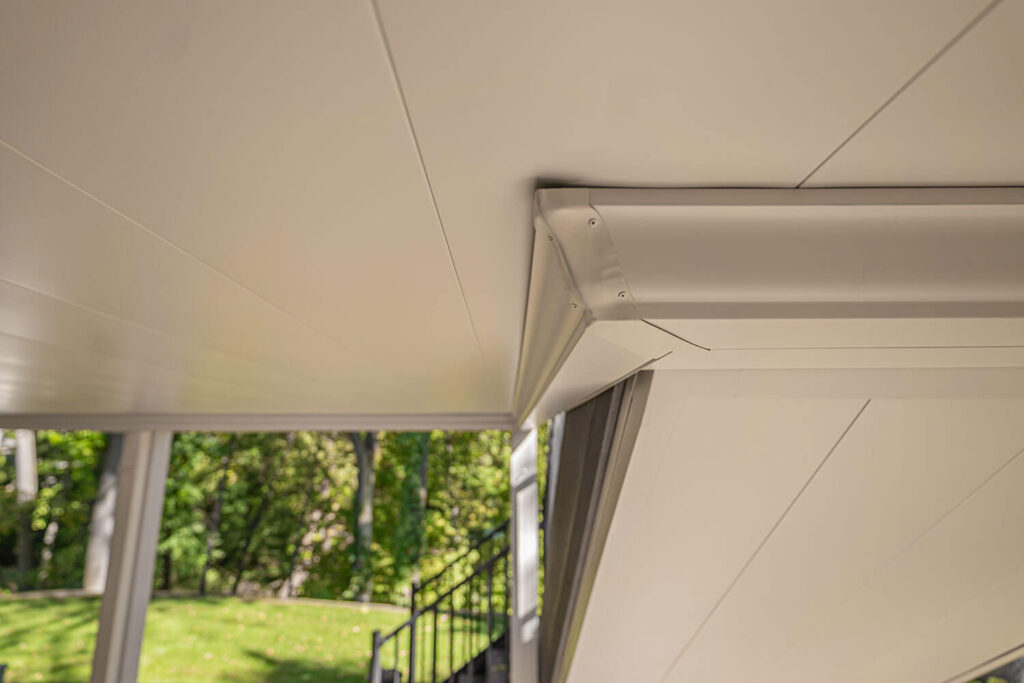
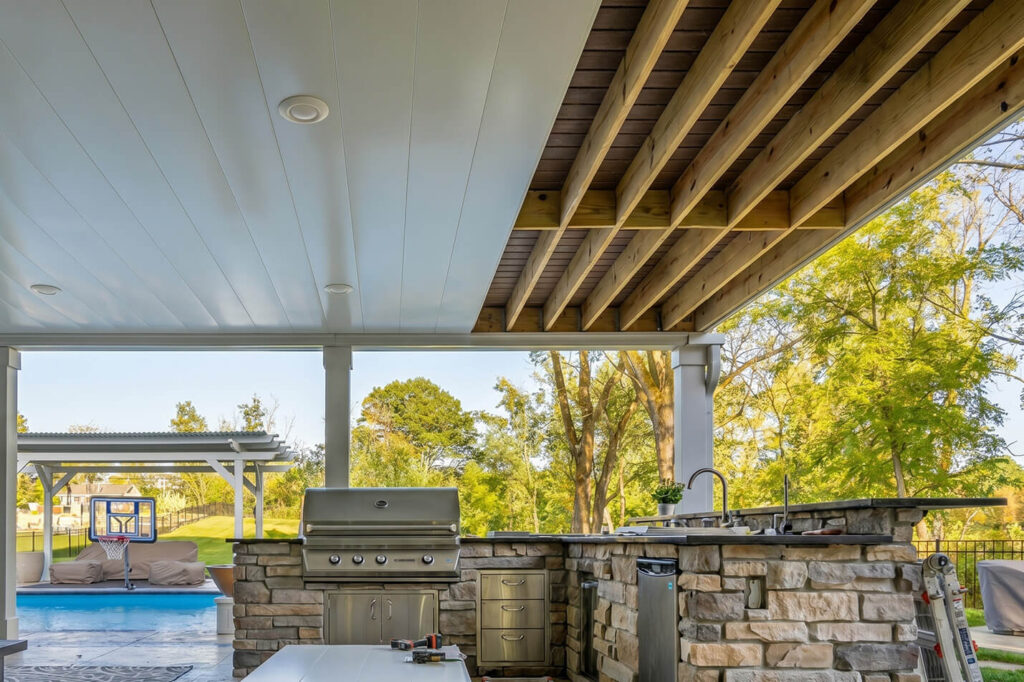
If you're new to this, here is the quick rundown: An under deck ceiling is a waterproof panel system installed beneath your existing deck. It catches rainwater that would otherwise drip through the gaps in your deck boards and channels it away through gutters and downspouts. What you end up with is a dry, finished area below your deck that you can actually use.
Most underdeck quotes start with a base square-foot cost. This number covers the panels themselves, the support track or hangers, the gutters and downspouts that move water out of the system, and the labor to install everything. That number is your starting point, not your finish line. Here is what determines how far from that baseline your actual project ends up.
Factor One: Deck Size and Shape
We start with the most obvious factor. A 12 by 16 foot deck has 192 square feet of coverage. A 20 by 24 foot deck has 480 square feet. The math is straightforward when the deck is a clean rectangle.
Things get a little more difficult when decks have angles, curves, wrap-around sections, and unusual cutouts around posts and pillars. Each of these adds installation time and material waste, meaning that if your deck is non-rectangular, it does have the potential to raise the overall cost of the project.
Coverage area is also why a small deck with premium features and a large but basic deck can end up at similar totals. Square footage drives the base number, but features per square foot drive the rest.
Factor Two: Waterproofing System Quality
There are cheap under deck waterproofing options, and there are quality ones. We talk all about the range of underdecking materials in use in this article. Quality systems, like the Magnolia Underdeck System, use rigid aluminum panels with a real gutter and downspout system, designed to handle the actual weather a Midwest deck sees in an average year.

The materials that a contractor chooses to install will that difference. Contractors installing budget rubber membranes or cheap PVC panels will give you very inexpensive quotes, but you're essentially buying yourself a leaky ceiling and an unexpected redo in a few seasons. A real aluminum underdeck system costs a bit more up front, but saves you a lot of headaches.
If a quote looks too good to be true, ask what panel material the contractor uses. This is the question that separates the systems that are built to last from the systems built to look "okay" for now.

Factor Three: Lighting Package
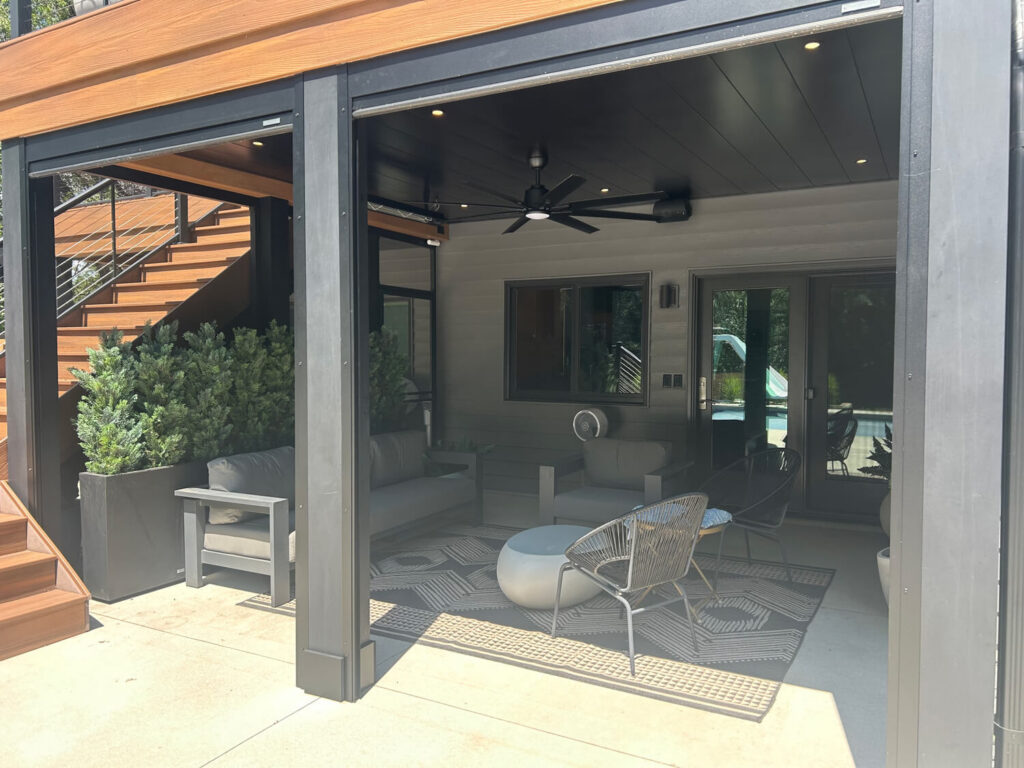
Adding recessed lighting to your under deck ceiling is one of the highest impact upgrades you can make. Our typical lighting package includes six to eight recessed lights wired into the new ceiling, and it really makes the difference between a finished (but dark) underdeck patio and a versatile outdoor room.
Lighting cost depends on the number of fixtures, the type of switch or smart control, and how easy it is to tie into your home's existing electrical. Expect quality lighting to come in somewhere in the low thousands.

Factor Four: Ceiling Fans
Outdoor ceiling fans get more popular every summer, and there's a reason. A breeze across an outdoor room can drop the perceived temperature by 3 - 8 degrees on a hot and humid day.
Installation cost is going to depend primarily on the number of fans you want to add. When we install our system, we request the customer picks out and provide their own preferred fan that matches their desired style. We then handle the wiring and mounting, which keeps the per-fan installed cost reasonable and flexible to your budget. The fan does have to be rated for outdoor use, as a regular indoor ceiling fan will rust and fail in an open-air environment, no matter how sheltered the under deck space feels.
Factor Five: Outdoor Outlets
Once they have a finished, dry space below their deck, the first thing many of our customers want is to plug things in. String lights. A TV. A sound system. A phone charger. Outlets have a lot of function in your new outdoor room.
Outlet installation cost depends on how far the new outlet needs to run from existing wiring and whether the location requires a GFCI breaker for code compliance (most outdoor outlets do). Each outlet typically lands in the low to mid-hundreds installed. Whether you are planning to just add a TV or a more complex setup with multiple outlets, discuss it early with your contractor, so they can size the circuit properly.
Factor Six:
Hidden Exhaust Ventilation
This is a cost that's rarely talked about, and that's a mistake. The cavity between your deck boards and your underdecking panels is a closed-off space, and without ventilation it stays damp, especially during humid midwest summers. Damp wood plus closed air equals premature deck rot.
A hidden exhaust system sits above the panels and gently moves air through that cavity, keeping the joists and underside of your deck boards dry. It's a feature that adds a modest amount to your project cost, while doing a lot of work long-term to protect the deck above it. If you are investing in a quality under deck ceiling, this is one of the simplest ways to protect the rest of your deck.
Factor Seven:
Patio Heaters
Ceiling-mounted patio heaters extend your outdoor season by months. In Minnesota and the rest of the upper Midwest, where summer evenings have a tendency to turn chilly early, that's a big deal.
Heaters are on the pricier side when it comes to underdeck addons. Each mounted unit pulls a lot of power, and requires its own dedicated electrical circuit. The unit itself, the dedicated circuit, the wiring run, and the installation push the cost-per-heater into the low thousands.
Most homeowners doing this install one or two heaters, evenly spaced, and find that is enough to keep a 300 to 400 square foot space comfortable well into October.
Factor Eight: Screens
If you want to fully enclose the under deck space, motorized or fixed screens are the way to do it. Bugs disappear, wind gets cut down significantly, and you effectively get a three-season room without ever putting up a wall.
Screen pricing varies too much to throw out a general number here. It depends on a number of factors, including the dimensions of each opening, whether you want motorized retractable screens or fixed mesh panels, the screen material itself, and how the screens integrate with your deck's posts and beams. A quick phone consultation or a site visit is the only realistic way to quote screens, which is why we don't include them in our online estimator tool on this site.
What Your Money Gets You: 3 Different Levels of Underdecking
Here is a rough framing of what to expect from common project tiers. These are ballparks, not quotes, and our easy online estimator tool will get you closer to your real number.
A basic underdeck install on a small 12x16 deck, with just the panels and gutters and nothing else, generally runs in the high four digits, around $8,000 as of summer 2026. You get a dry space below the deck, which is the main thing. No lighting, no fans, no outlets, just a clean, finished surface above a usable patio.
A mid-tier project on a 20x20 deck, with a lighting package, a ceiling fan, and a hidden exhaust system pushes that to just under $20,000. This configuration is a sweet spot for most homeowners, and turns their under deck space into a great place to hang out and enjoy life, both during the day and after dark.
Frequently Asked Questions
A truly deluxe outfitted outdoor room on a larger 30x20 deck, with multiple ceiling fans, patio heaters, several outdoor outlets, and lighting can easily push into the mid $30,000s. This is the type of setup that makes your space competitive with a full-on screened porch addition, at a fraction of what that addition would cost.
Those ranges blur at the edges and depend heavily on your specific deck, but they're a useful starting point for budget conversations.
Is It Worth the Cost?
Absolutely. A finished, dry, lit, ventilated space below your deck adds real living square footage to your home without the cost of a full addition. You just can't get an addition's worth of finished square footage for the price of underdecking, but you absolutely can get an incredibly versatile outdoor room, that you can enjoy for years to come.
For most homeowners who use their deck regularly, the return is beyond worth it.
How to Get an Accurate Number for Your Project
Looking to quote your own project? The fastest way is to use our under deck ceiling cost estimator. Plug in your deck dimensions, toggle the add-ons you're considering, and you'll see a live estimated range that updates as you make decisions. It takes about a minute.
For a verified and accurate quote, you'll need to schedule a site visit. There are too many variables involved for any contractor to lock in a final number without seeing the deck in person. The estimator gets you in the ballpark. The site visit gets you the rest of the way.
If you are at the budgeting stage and just want to know whether an underdeck fits your needs, the calculator is the right place to start. If you are ready to move forward, get in touch and we will get a site visit scheduled!